



Get Found Where It Matters: On Google

We help contractors and small businesses dominate local search with SEO, Google Ads, and high-converting websites.

Results That Speak Volumes

Numbers don’t lie. Here’s what we’ve achieved for our clients across the nation.

500+

GBPs Under Management

Google Business Profiles optimized and managed

100k+

Calls Generated

Phone calls driven to local businesses

$100M+

Revenue Generated

Total revenue generated for our clients

300%

Average Growth

Average increase in online visibility

Proof Over Promises

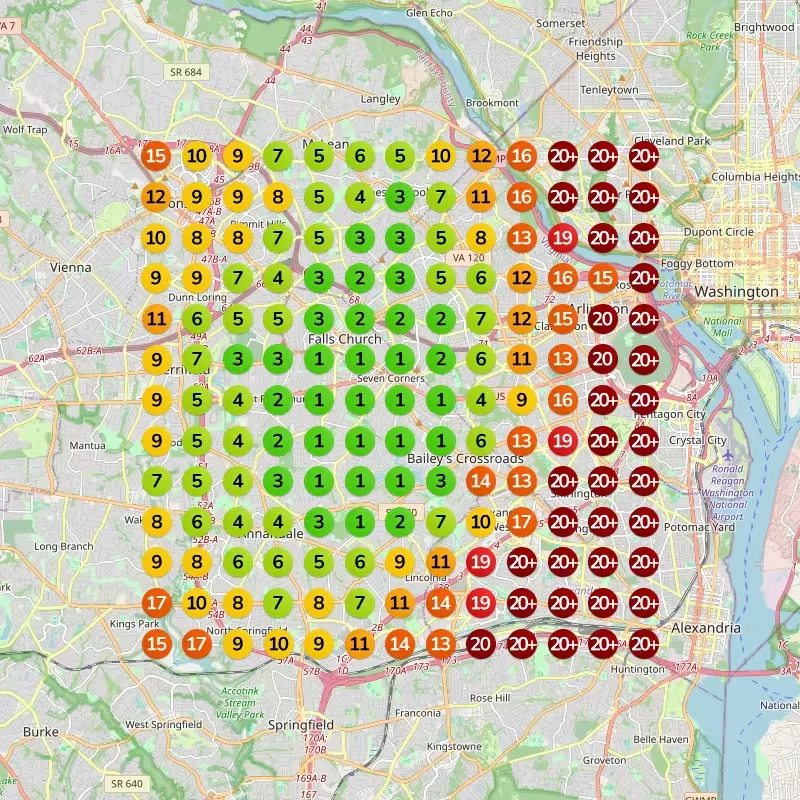
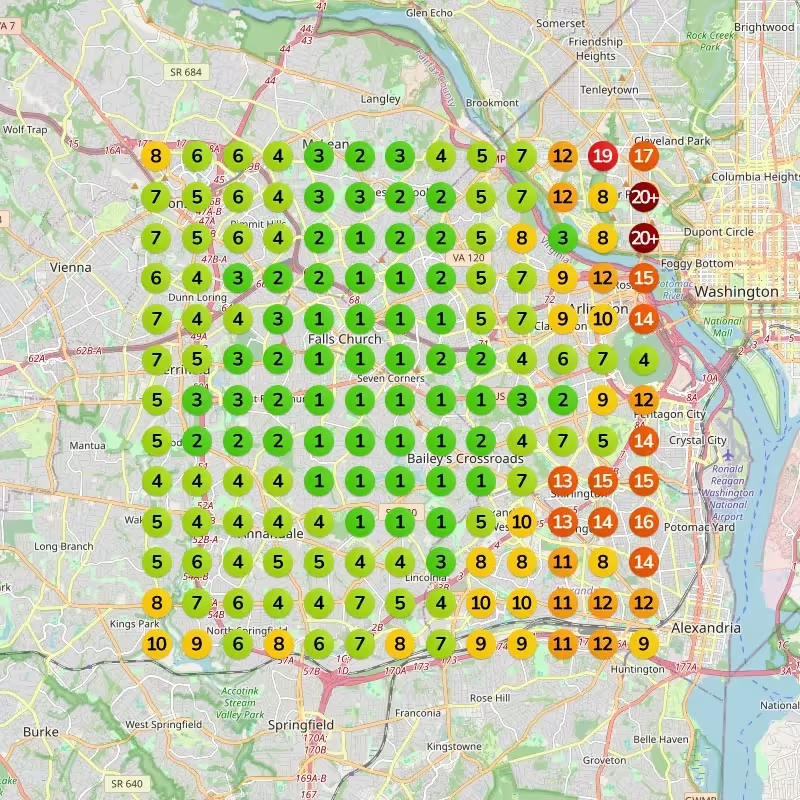
Real Local SEO results showing dramatic improvements in Google Business Profile visibility and rankings.

Local SEO Transformation

Dramatic visibility increase for “home remodeling” searches

Before

August - Poor Rankings

After

October - Dominating Results

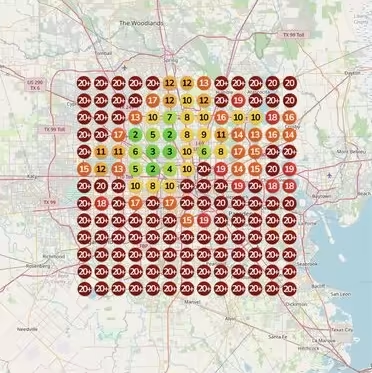
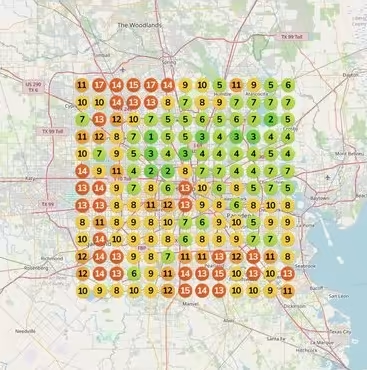
Google Business Profile Rankings

From scattered presence to top 3 rankings across service area

Before

October - Low Visibility

After

September - Market Leadership

Real Results. Real Clients.

See what business owners are saying about their transformation

4.9/5 Average Rating

Get a Free Local SEO Audit

We’ll send you a custom report showing how visible your business is on Google—and where you can improve.

Latest Digital Marketing Insights

Expert tips and strategies from our digital marketing specialists to help your business dominate local search results

Mobile-First Design: Why It Matters for Local Businesses

Understanding the importance of mobile-first design and how it impacts your local search rankings.

Pop quiz: When was the last time you looked something up on your phone? If you’re like most humans, it was probably within the last hour. Maybe even within the last few minutes.

Now here’s the kicker – if your website looks terrible on mobile devices, you’re essentially hanging a “Closed” sign on your digital storefront. And unlike physical stores, your digital storefront never actually closes.

The Mobile Takeover is Complete

Let’s get the scary statistics out of the way: Mobile devices account for over 60% of all web traffic. For local searches (you know, the “near me” searches that actually bring you customers), that number jumps even higher.

When someone’s standing in their flooded basement at 11 PM searching for “emergency plumber near me,” they’re not firing up their desktop computer. They’re using their phone, and they need information fast.

Google’s Mobile-First Mandate

Here’s something that might surprise you: Google doesn’t even look at your desktop website anymore when deciding how to rank you. They use something called “mobile-first indexing,” which is a fancy way of saying “we only care about how your site works on phones now.”

This means:

  • Your mobile site performance affects ALL your rankings (even desktop)
  • Mobile page speed is crucial for local search visibility
  • If your mobile site sucks, your entire online presence suffers

It’s like Google put on mobile-colored glasses and refuses to take them off.

How Mobile Users Actually Behave

Mobile users are different creatures than desktop users. They’re usually:

  • In a hurry: They want information NOW, not after your 30-second loading animation
  • On the move: They might be driving, walking, or multitasking
  • Task-focused: They have a specific goal in mind
  • Impatient: They’ll bounce faster than a hyperactive kangaroo if your site doesn’t work

Understanding this behavior is key to designing for mobile success.

Mobile-First Design Principles That Actually Work

1. Speed is Everything (And I Mean Everything)

Your mobile site should load in under 3 seconds. Not 3.5 seconds. Not “pretty close to 3 seconds.” Three seconds or less.

How to get there:

  • Optimize images (that 8MB photo from your camera doesn’t need to be 8MB on your website)
  • Minimize code (clean out the digital junk drawer)
  • Use a CDN (it’s like having copies of your site all over the world)
  • Choose good hosting (cheap hosting is usually cheap for a reason)

2. Make Everything Touch-Friendly

Fingers are bigger than mouse cursors. Design accordingly.

  • Buttons should be at least 44 pixels tall (Apple’s recommendation, and they know a thing or two about touchscreens)
  • Leave space between clickable elements (nobody likes accidentally calling a business when they meant to scroll)
  • Use readable fonts (minimum 16px – if people need reading glasses to see your text, you’ve failed)
  • Implement swipe gestures where they make sense

3. Simplify Your Navigation

Mobile screens are small. Your navigation needs to acknowledge this reality.

  • Use hamburger menus for complex navigation (those three lines everyone recognizes)
  • Prioritize your most important pages
  • Include a search function (sometimes people just want to find something specific)
  • Make contact info easy to find (preferably with click-to-call functionality)

4. Local-Focused Mobile Content

Mobile users searching for local businesses want specific information:

  • Your phone number prominently displayed (with click-to-call, because typing phone numbers is so 2005)
  • Clear address and directions
  • Business hours (especially if you have weird hours)
  • Location-based calls-to-action

The Bottom Line

Mobile-first design isn’t just a nice-to-have anymore – it’s table stakes for local businesses. Your customers are on their phones, Google cares about mobile experience, and your competitors are (hopefully) taking this seriously.

If your website feels more like a desktop relic than a mobile-friendly tool, our website design services specialize in creating mobile-first experiences that actually convert visitors into customers.

Remember: In a mobile-first world, your website’s mobile experience isn’t secondary – it’s everything.

Website Design Trends That Convert Visitors to Customers

Learn about the latest web design trends that not only look great but also drive conversions.

Let’s be honest – having a beautiful website that doesn’t convert visitors into customers is like having a gorgeous storefront with the door welded shut. It might win design awards, but it won’t pay your bills.

I’ve seen way too many businesses obsess over making their website look like a work of art while completely forgetting that its main job is to turn visitors into paying customers. So let’s talk about design trends that actually work in the real world, not just in design competitions.

1. Mobile-First Design (Because Everyone Lives on Their Phone)

Remember when people used to sit at actual computers to browse the internet? Yeah, me neither. These days, over 60% of web traffic comes from mobile devices, and for local businesses, that number is even higher.

Your website needs to work perfectly on smartphones, or you’re basically telling potential customers to take their business elsewhere.

What mobile-first actually means:

  • Touch-friendly everything: Buttons big enough that people don’t need tweezers to tap them
  • Lightning-fast loading: Because nobody has patience for slow websites anymore
  • Text you can read without a magnifying glass
  • Forms that don’t make people want to throw their phone
  • Click-to-call buttons (revolutionary, I know)

2. Value Propositions That Don’t Suck

Your homepage has about 3 seconds to answer the question: “What’s in it for me?” If visitors have to play detective to figure out what you do or why they should care, they won’t. They’ll bounce faster than a bad check.

Here’s what actually works:

  • Headlines that make sense to humans (not just to you and your industry insider friends)
  • Benefits, not features: People don’t care that your widget has 47 different settings; they care that it saves them time
  • Social proof that feels real: Real testimonials from real people, not stock photo models
  • Clear calls-to-action that tell people exactly what to do next

3. Trust Signals (Because the Internet is Full of Scammers)

The internet has trained people to be suspicious, and for good reason. Your website needs to work overtime to prove you’re legit.

Build credibility with:

  • Customer testimonials with actual names and photos (not “John D. from Denver”)
  • Industry certifications and badges (if you’ve got ’em, flaunt ’em)
  • Security badges (especially if you handle payments)
  • Professional photography (please, no more blurry phone pics)
  • Case studies that show real results

4. Navigation That Makes Sense

Your website navigation should be so intuitive that your grandmother could use it after a couple glasses of wine. If people need a map to find what they’re looking for, you’ve failed.

Keep it simple:

  • Stick to 7 or fewer main menu items (human brains can only handle so much)
  • Use words people actually search for (not clever marketing terms)
  • Make it consistent across all pages
  • Add a search function for the inevitable “I just want to find X” visitors

5. Speed That Doesn’t Test People’s Patience

Here’s a fun fact: for every second your page takes to load, you lose potential customers. After 3 seconds, people start getting antsy. After 5 seconds, they’re gone.

Speed up your site by:

  • Compressing images (that 5MB photo from your phone doesn’t need to be 5MB on your website)
  • Cleaning up your code (get rid of the digital equivalent of junk in your trunk)
  • Using a good hosting provider (bargain hosting is usually bargain for a reason)
  • Implementing a CDN (it’s like having multiple copies of your site around the world)

The Real Secret Sauce

Here’s what most web designers won’t tell you: the best website design is the one that gets out of the way and lets your customers do what they came to do. It’s not about winning design awards; it’s about making it ridiculously easy for people to hire you, buy from you, or contact you.

Think of your website like a good waiter – helpful when you need them, invisible when you don’t.

If your current website feels more like a maze than a welcome mat, our website design services focus on creating sites that actually convert visitors into customers. Because at the end of the day, that’s what matters, right?

Remember: Pretty websites are nice, but profitable websites pay the bills.

The Ultimate Guide to Local Keyword Research

Master the art of finding the right local keywords that your customers are actually searching for.

Keyword research is like being a detective, except instead of solving crimes, you’re solving the mystery of what your customers actually type into Google. And trust me, what they search for is often very different from what you think they search for.

I’ve seen too many businesses optimize for keywords that sound professional but nobody actually uses. Don’t be the business optimizing for “residential plumbing solutions” when everyone’s searching for “fix my toilet.”

Understanding How People Actually Search

Here’s the thing about local searches – they fall into three main categories, and understanding the difference is crucial:

  1. Informational searches: “How do I unclog my drain?” (They’re trying to DIY it first)
  2. Navigational searches: “ABC Plumbing phone number” (They already know who they want)
  3. Transactional searches: “Emergency plumber near me” (They need help NOW and are ready to pay for it)

Guess which ones you should focus on? If you said transactional, you win a cookie. These people have their wallets out and are ready to hire someone.

Your Keyword Research Toolkit

The Free Tools (Because Who Doesn’t Love Free?)

  • Google Keyword Planner: Basic but reliable, like a Honda Civic
  • Google Autocomplete: Just start typing and see what Google suggests
  • Google My Business Insights: Shows you what people searched to find you
  • Answer the Public: For when you want to know what questions people are asking

The Paid Tools (For When You Get Serious)

  • SEMrush: The Swiss Army knife of SEO tools
  • Ahrefs: Great for competitive analysis
  • Moz Local: Specifically designed for local businesses
  • BrightLocal: Another local SEO specialist

Types of Local Keywords (AKA How People Actually Search)

Geographic Modifiers (The “Where” Part)

People search with location in mind:

  • City names: “Denver HVAC repair”
  • Neighborhoods: “Capitol Hill electrician”
  • Landmarks: “plumber near Union Station”
  • The famous “near me” searches (because typing your address is apparently too much work)

Service + Location Combos

This is where the magic happens:

  • “Service + City”: “roof repair Austin”
  • “Service + Area”: “landscaping North Denver”
  • “Service + Zip Code”: “electrician 80203”

Your Step-by-Step Research Process

1. Start With What You Actually Do

List every service your business offers. Be specific. Don’t just write “plumbing” – write “toilet repair,” “drain cleaning,” “water heater installation,” etc.

2. Spy on Your Competitors (Legally)

See what keywords your local competitors are ranking for. Tools like SEMrush and Ahrefs make this easy. If they’re ranking for something, there’s probably search volume for it.

3. Listen to Your Customers

Pay attention to how your customers describe your services. They might call it “fixing my garbage disposal” while you call it “waste disposal unit repair.” Use their language, not yours.

4. Balance Volume and Competition

You want keywords with decent search volume but manageable competition. Going after “plumber” might seem like a good idea, but you’ll be competing with every plumber in the universe.

5. Think About the Customer Journey

Create keywords for different stages:

  • Awareness stage: “Signs I need a new furnace”
  • Consideration stage: “Best HVAC companies Denver”
  • Decision stage: “Emergency HVAC repair Denver”

The Power of Long-Tail Keywords

Don’t overlook longer, more specific phrases. They might have lower search volume, but they often have higher conversion rates:

  • “24 hour emergency plumber downtown Denver”
  • “Licensed electrician residential Capitol Hill”
  • “Affordable roof repair near me with warranty”

These people know exactly what they want. They’re basically raising their hand and saying “I’m ready to buy.”

Organizing Your Keyword Chaos

Once you have your keywords, organize them by:

  • Service type (plumbing, electrical, HVAC, etc.)
  • Location (city, neighborhood, service area)
  • Search intent (informational, navigational, transactional)
  • Competition level (easy wins vs. long-term goals)

The Reality Check

Here’s what nobody tells you about keyword research: it’s not a one-and-done activity. Language evolves, search trends change, and new competitors enter the market. What worked last year might not work this year.

Also, don’t get so caught up in keyword research that you forget to actually optimize your website and create content. Research without action is just expensive procrastination.

If you’re feeling overwhelmed by all this keyword detective work, our local SEO services include comprehensive keyword research and ongoing optimization. We handle the research so you can focus on serving the customers who find you.

Remember: The best keywords are the ones your customers actually use to find businesses like yours. Everything else is just noise.